
He replaced a Google salary with weekly option premiums.
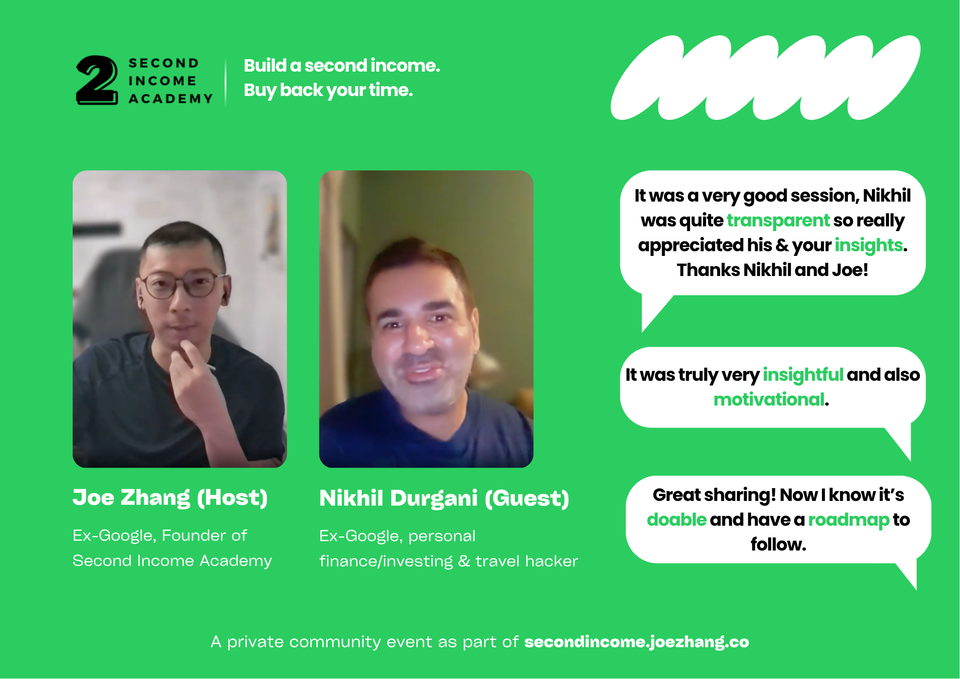
At this week's Second Income Academy community call, I did something different and handed the mic to a guest.
Nikhil left a 15.5 years career at Google earlier this year. Two kids under five. Now covering his living expenses from option premiums instead of a regular payslip.
We arrived at this independently, from different portfolios, and landed on almost the same philosophy that I used to build the Second Income Academy curriculum.
Eight things that stuck with me from his sharin:
- Financially independent ≠ retired. He calls it "job optional." Money stopped being the motivator. Time became the thing he was actually buying. I never quite like the term FI/RE either. Financial independence, yes. But the goal here is for us to them channel our time and energy building something we want. For me, it’s about building up the business now.
- Your FIRE number isn't a number. It's three variables.Location. Age. Lifestyle. FIRE in Singapore as a foreigner with kids in international school is a different maths problem entirely.
- His biggest losses were emotional, not analytical.A position kept falling. He averaged down instead of cutting, and rode it to -99.6%. His reason for it: ego. → This is where I am aligned with him - we need to have an exit strategy because nothing good last forever. A great stock may have its big fall too.
- Never sell options on a stock you'd hate to own. Don't chase the premium. Don't chase the volatility. If you wouldn't hold it through a drawdown, the premium isn't compensation — it's bait. → Same reason we give students a screener. Fundamentals and checklist filters first, premium second. Never the other way round.
- Ladder your strikes. He didn't want an entire position called away at one price. So he split it across several strikes and let it go in tranches.
- Set a realistic bar, then respect it. T-bills do 3-4%. The index has done ~12-14%. His target is 18-20% a year — roughly 0.5% a week. → I hold the same line: I won't execute a trade that doesn't clear ~18-20% annualised return. And no more than 20% of the portfolio does this work. The other 80% compounds quietly while the premiums get recycled back into it.
- The hidden return is knowledge. Selling weekly options forced him to actually understand what he owns. When something drops 5%, he now asks the only question that matters: is this the market, or is this the business?
- Complexity has to earn its place. On advanced spreads: if capping both ends leaves you with 0.5%, is the juice worth the squeeze?
Know your number. Size your risk. Cut early. Stay honest about the moment your ego takes the wheel.
Keep growing!